The Material Algorithm
AI scaling is no longer governed only by models, chips, or capital. As power, grid access, cooling, and regulatory friction become binding constraints, the grid itself begins to determine which compute becomes real.

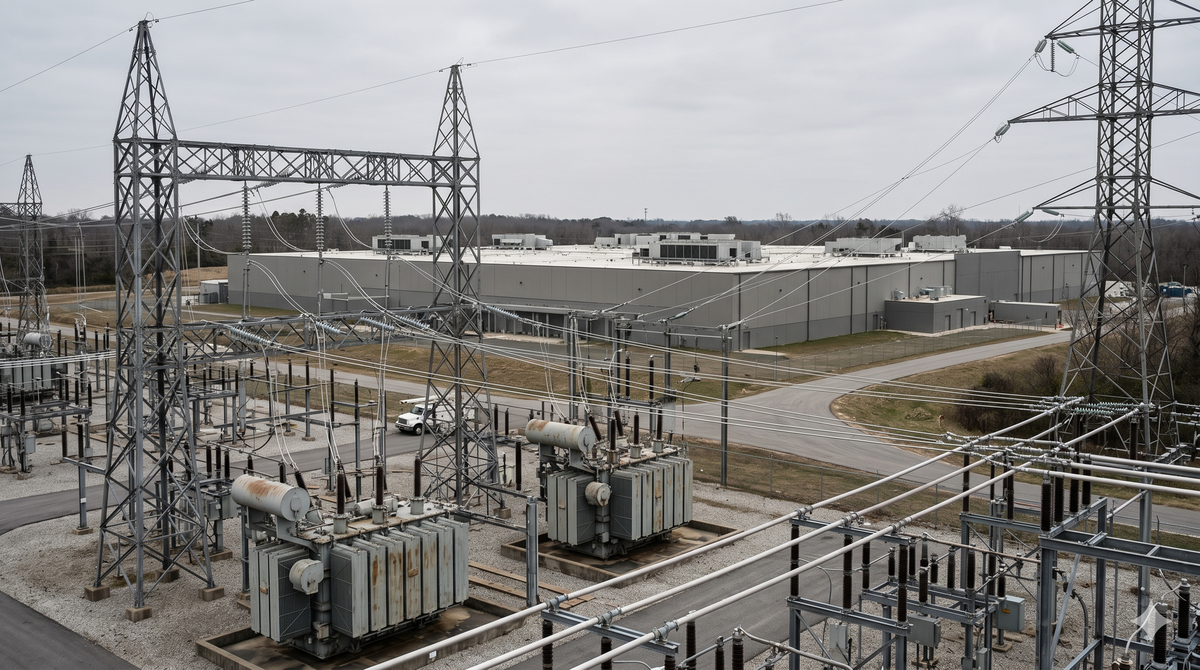
Artificial intelligence is still often described as a software frontier. The public language around it remains attached to models, benchmarks, chips, applications, and investment rounds. In that framing, computation appears as a resource that can be expanded by capital, compressed by engineering, and directed by strategic ambition. The central question becomes how much intelligence can be produced, how quickly models can improve, and how far software can extend itself into economic and institutional life.
That framing is now incomplete.
The scaling frontier of artificial intelligence is no longer governed only by model design, semiconductor supply, or available capital. It is increasingly governed by a slower and more material control layer: power generation, transmission capacity, grid interconnection, cooling physics, land use, regulatory latency, and the supply chain for heavy electrical equipment. These systems do not merely support AI deployment. They filter it. They delay it. They price it. They route it toward some geographies and away from others. They determine which compute plans become operational infrastructure and which remain abstractions on a capital expenditure schedule.
The decisive shift is not that AI uses more electricity. That observation is true, but too shallow. The deeper shift is that energy infrastructure has ceased to be a background dependency and has become part of the governing logic of computation itself. The physical layer is no longer external to the AI system. It now participates in deciding what scale is possible.
In this sense, the grid has become a material algorithm.
The phrase is useful only if treated analytically, not decoratively. A software algorithm selects through rules, weights, inputs, and objective functions. The grid selects through capacity, delay, cost, reliability requirements, political permission, and cost allocation. Its objective function is not intelligence, novelty, or model quality. It is reliability, recoverable investment, system stability, regulatory legitimacy, and the credible assignment of infrastructure costs.
That distinction matters. The grid does not select for the best model. It selects for projects that are legible to utilities, financeable under regulatory scrutiny, compatible with existing transmission and generation assets, able to procure scarce electrical equipment, and willing to internalize enough system cost to avoid political rejection. These selection pressures will not produce a neutral AI economy. They will tend to favor actors with capital depth, infrastructure relationships, site control, regulatory competence, and the ability to make long-horizon physical commitments under uncertainty.
The Grid as Selection Mechanism
- Load requests
- Interconnection positions
- Equipment availability
- Site characteristics
- Financing commitments
- Regulatory filings
- Water access
- Local politics
- Tariff structures
- Reliability obligations
- Capital recovery rules
- Cost-causation principles
- Public legitimacy
- Institutional risk tolerance
- Built infrastructure
- Delayed projects
- Relocated campuses
- Higher costs
- Canceled plans
- Concentrated compute access
It optimizes for reliability, recoverable investment, and the credible assignment of infrastructure costs.
Only after those tests are passed does compute become real.
The End of Compute as Abstraction
The digital economy has long depended on a useful abstraction: that computation is elastic. Software businesses could treat compute as a cloud resource, available through APIs, scaled by usage, priced by contract, and largely invisible to the user. Even when computation depended on vast physical systems, the interface presented it as an expandable service. Capacity appeared to follow demand. If more processing was required, more could be provisioned. If a workload grew, infrastructure teams could scale it. The physical world existed, but it was hidden behind cloud platforms, data center campuses, and procurement cycles.
Artificial intelligence has strained that abstraction because its scaling profile is different. Large-scale AI systems require not only more computation, but a different kind of physical continuity. Training clusters and high-volume inference environments depend on dense concentrations of hardware, persistent energy draw, specialized cooling, and high-reliability power delivery. Their requirements are not equivalent to adding conventional servers to an existing enterprise workload. They impose large, continuous, concentrated loads onto physical systems that were not planned around such demand.
This matters because electricity infrastructure is not elastic in the same way software infrastructure appears to be. A model can be updated quickly. Chips can be purchased on compressed strategic timelines if supply is available. Capital can be allocated in a quarterly cycle. But transmission lines, substations, transformers, turbines, cooling systems, and grid interconnection studies operate on a different temporal regime. They are built through years of planning, permitting, manufacturing, installation, and regulatory approval.
The mismatch is structural. AI hardware cycles move at the pace of technology competition. Grid infrastructure moves at the pace of industrial systems and public authority. The former pushes toward acceleration; the latter imposes sequence, locality, and delay.
But the mismatch is not only temporal. It changes what counts as a viable AI strategy. A company can no longer treat infrastructure as the final step after capital, models, and chips have been secured. The physical sequence now comes earlier. Access to power, grid position, cooling feasibility, and local permission are not deployment details. They are upstream conditions that determine whether the strategy can exist.
This is where the illusion of infinite compute breaks. The constraint is not simply that energy demand rises. It is that the physical substrate cannot be expanded at the same speed as the computational ambition built on top of it. Software can imagine scale faster than the grid can materialize it.
Why AI Load Is Different
Not all electricity demand has the same meaning for a grid.
The significance of AI infrastructure is not only the quantity of power it consumes, but the pattern, density, and operational requirements of that consumption. A large AI cluster is not a conventional commercial customer. It requires substantial power capacity, often concentrated in a single site or campus, with high expectations of reliability and continuity. It draws power not as a fluctuating residential load but as an industrial system designed to operate near full capacity for long periods.
This changes the planning problem. A grid can manage variability when demand follows familiar rhythms. Residential consumption rises and falls with daily activity and weather. Commercial load follows business cycles. Industrial load can be large, but it is often integrated into established planning regimes. AI clusters introduce a dense and rapidly expanding class of demand that can appear faster than the infrastructure needed to serve it.
They also compress technical constraints into specific places. The question is not only whether a region has enough electricity in aggregate. It is whether power can be delivered to a specific site, at a specific voltage, through specific transmission and distribution assets, within a specific timeline, without destabilizing the surrounding system or imposing unacceptable costs on other users.
The thermal dimension compounds the problem. Dense AI hardware produces heat at levels that push beyond traditional cooling assumptions. As rack densities rise, cooling becomes an architectural constraint rather than a facilities detail. Water, climate, land, and heat rejection become part of the computation stack. A site that looks attractive from a fiber or tax perspective may be constrained by water availability, ambient temperature, or local resistance to resource consumption.
In practical terms, the map of AI deployment becomes a map of material constraints. The next cluster is not placed only where latency, real estate, or tax treatment are favorable. It is placed where power can be secured, where transmission can be accessed, where cooling can be sustained, where permits can be obtained, and where the political cost of industrial-scale computation can be managed.
The internet once seemed to flatten location. Cloud computing softened the importance of place for many users. AI reverses part of that logic. Large-scale computation becomes territorial again.
The Hidden Bottleneck Stack
For several years, the most visible bottleneck in artificial intelligence was the chip. GPUs became the symbol of scarcity because they were legible to the technology sector: specialized hardware, concentrated supply, strategic demand, high margins, and direct relevance to model performance. That bottleneck remains important. But it is no longer sufficient to understand the constraint surface.
A chip that cannot be powered is not compute capacity. A server rack that cannot be cooled is not usable infrastructure. A data center without an interconnection agreement is not an operational AI facility. A campus delayed by transformers, switchgear, substations, or transmission upgrades is capital waiting for the physical world to catch up.
The bottleneck has widened from silicon to the electrical substrate beneath silicon.
This substrate includes generation, but generation alone does not solve the problem. New power must be connected. It must be transmitted. It must be transformed. It must be delivered through equipment that has its own manufacturing constraints. It must satisfy reliability requirements. It must pass through regulatory processes and local approvals. Each layer can become the binding constraint.
The heavy electrical supply chain is especially revealing because it is less visible than chips but often slower to expand. High-voltage transformers, medium-voltage switchgear, turbines, batteries, and related components are not produced on software timelines. Wood Mackenzie has reported lead times of 18 to 36 months for critical data-center electrical components, while research on large transformer procurement shows transmission-class units and generator step-up transformers stretching into multi-year windows that can exceed the useful planning horizon of a particular AI hardware generation.
That fact changes the meaning of capital. In a capital-rich environment, the assumption is often that bottlenecks can be bought through. But money does not instantly create transformer capacity. It does not instantly produce skilled installation crews, expand factory output, shorten permitting timelines, or build transmission corridors. Capital can bid for priority. It can secure options. It can raise prices. It can move faster than less capitalized actors. But it cannot eliminate the physical sequence required to turn energy into reliable compute.
That sequence has become strategically decisive.
The most important variable in a data center project may no longer be the theoretical capacity of the facility. It may be speed-to-power: the time required to secure usable, reliable electricity at the scale the facility requires. A site with less favorable traditional real estate characteristics may become more valuable than a superior site if it has access to power, an existing interconnection position, or a more navigable permitting environment.
This is not theoretical. In Abilene, Texas, the OpenAI–Oracle–Crusoe buildout associated with the Stargate infrastructure effort was reportedly scaled back from an immediate 600 MW expansion toward a smaller phased 200 MW initial build, with equipment and power constraints becoming part of the deployment logic. Crusoe's response was not merely to wait for the market. It began vertically integrating parts of the power-distribution stack, including proprietary power distribution centers, and pursued onsite turbine generation through GE Vernova to bypass portions of the traditional grid and equipment bottleneck.
This changes the logic of infrastructure competition. The scarce asset is not simply land. It is not simply chips. It is not simply capital. It is the combination of power rights, grid access, equipment availability, cooling feasibility, and political permission.
The material algorithm weighs inputs that the software economy historically treated as peripheral: interconnection rights, transformer access, regulatory trust, and credible load commitments. It selects for the capacity to materialize computation, not merely to finance or describe it.
The Queue as Governor
The most revealing feature of this new regime is the interconnection queue.
In software, a queue is often an operational inconvenience. In energy infrastructure, it is a governance mechanism. It determines the order in which projects can connect to the grid. It requires engineering studies, reliability assessments, cost allocation decisions, and coordination across public and private actors. It is slow because it is not merely administrative. It exists to prevent physical systems from being overloaded by poorly sequenced demand.
For AI infrastructure, the queue becomes a throttle on deployment. A company may have capital, hardware contracts, land, customer demand, and strategic urgency. But if it cannot connect its load to the grid, the project cannot operate. The queue converts physical system limits into institutional delay.
This delay has consequences beyond scheduling. It changes behavior.
Developers may submit speculative or duplicate requests in multiple jurisdictions to secure a place in line. Utilities may struggle to distinguish real demand from inflated or contingent demand. Forecasts become distorted. Planning assumptions become unstable. Infrastructure may be proposed for loads that may not fully materialize. Other users may be asked to share the cost of grid upgrades driven by projects whose final viability remains uncertain.
The pathology is already visible in Texas. ERCOT found that among large-load projects expected to be in service in 2024, only 55.4 percent were active by early 2025, and realized load was only 49.8 percent of the initially requested amount. That gap is not just forecasting error. It is a sign that large-load pipelines increasingly contain strategic optionality, not only committed infrastructure demand.
Utilities and regulators are responding by turning queues into credibility filters. ERCOT's large-load reforms and related Texas rulemaking have moved toward higher financial security, including a $50,000-per-MW requirement for certain large-load requests. Other large-load tariff designs apply the same logic through stricter readiness requirements, upfront commitments, and minimum billing obligations.
These mechanisms are often described as tariffs or queue reforms, but structurally they do something more precise. They force demand to reveal whether it is credible. When the penalty for overstating demand is a modest study deposit, optionality is cheap. When the penalty becomes collateral, readiness milestones, or long-term payment exposure, optionality becomes expensive. The queue stops being a passive line and becomes a classification system.
A queue also reorders time. AI competition rewards speed, but interconnection imposes sequence. The result is a strategic search for ways around the queue: behind-the-meter generation, co-location with existing power assets, acquisition of sites with existing interconnection rights, partnerships with energy-intensive industries, and reuse of infrastructure originally built for other forms of computation.
These adaptations are rational. They are also evidence that the physical layer has become binding. When firms begin to reorganize strategy around bypassing or shortening energy infrastructure timelines, the grid is no longer a utility input. It is a competitive boundary.
The Political Economy of Scarcity
Physical scarcity does not remain physical for long. Once energy infrastructure becomes a constraint on AI deployment, it becomes a political economy problem.
The actors involved do not share the same incentives. Hyperscalers and AI developers want speed, reliability, exclusivity, and scale. Utilities must maintain system reliability, plan long-lived assets, justify expenditures, and manage public obligations. Regulators must decide how costs are allocated and whether new arrangements threaten fairness or reliability. Local governments weigh tax revenue and economic development against land use, water stress, electricity prices, and political backlash. Residents and businesses encounter the AI buildout not as an abstract technology transition, but as pressure on bills, landscapes, and public resources.
This produces conflict because the benefits and costs of AI infrastructure are not distributed evenly.
A data center campus may serve national or global digital demand while imposing localized infrastructure requirements. Transmission upgrades, substations, water use, and land conversion occur in specific communities. Electricity system costs can be distributed across broader rate bases. A project justified by private computational demand can generate public infrastructure questions: Who pays for the lines? Who absorbs the risk if demand forecasts are inflated? Who benefits from the resulting compute capacity? Who carries the reliability burden?
These questions are not secondary. They are becoming part of the AI deployment process itself.
The Susquehanna co-location dispute in PJM made this boundary visible. PJM, Talen Energy, PPL Electric Utilities, and Amazon Web Services sought to amend an interconnection agreement so that a co-located data center load at the Susquehanna nuclear facility could increase from 300 MW to 480 MW. FERC rejected the amended agreement in November 2024, with the dispute turning on whether the arrangement would improperly avoid transmission costs and shift grid reliability burdens onto other users.
The importance of the case was not merely that one data center expansion was blocked. It was that federal regulators had to decide whether a behind-the-meter or co-located AI load should be treated as private consumption or as network load that still depends on the broader grid for backup, reliability, voltage support, and system services. In 2025 and 2026, FERC pushed PJM toward new tariff categories for co-located load, making the hidden system dependency more explicit in rate design.
AEP Ohio's data center tariff shows the same logic at the state level. Approved by the Public Utilities Commission of Ohio in July 2025, it requires large new data center customers to pay for a minimum share of subscribed electricity capacity, with the 85 percent minimum becoming the defining mechanism. The stated rationale was to protect existing customers from infrastructure costs built for data center demand that might not fully materialize.
Maryland's objections to PJM transmission cost allocation extend the conflict across jurisdictional boundaries. The Maryland Office of People's Counsel challenged the allocation of billions in transmission upgrade costs to Maryland ratepayers for infrastructure tied substantially to data center growth elsewhere in the PJM region, especially Virginia and Ohio. The dispute is not about whether data centers need grid upgrades. It is about whether one jurisdiction's ratepayers should bear costs created by another jurisdiction's AI infrastructure economy.
Together, these cases show the institutional shape of the new regime. AI deployment is no longer a private siting decision that happens to use electricity. It is becoming a public-system negotiation over reliability, cost causation, network access, and the legitimacy of assigning shared infrastructure costs to users who may not directly benefit from the compute being built.
Large-load tariffs, upfront deposits, take-or-pay structures, moratoriums, and revised co-location rules are therefore not isolated policy reactions. They are mechanisms through which public institutions attempt to discipline the new demand regime. They make concentrated AI load legible to systems designed for slower and more predictable forms of growth.
AI infrastructure now enters the political logic of infrastructure: reliability, fairness, land use, rate design, public consent, and jurisdictional bargaining. A project that cannot justify its cost allocation may be delayed even if technically feasible. A facility that cannot secure local acceptance may be rerouted even if it has capital. A load that imposes too much unrecovered risk may face tariffs designed to force commitment before the system builds around it. What can be powered must also become publicly accommodable.
Geography, Leverage, and the Concentration of Compute
The shift from abstract compute to material compute changes the geography of the AI economy.
In earlier digital infrastructure phases, data center siting was shaped by fiber connectivity, proximity to users, tax incentives, land availability, and access to relatively inexpensive power. Those factors remain relevant, but their hierarchy is changing. The dominant question is increasingly whether a location can supply large amounts of reliable electricity within a viable timeframe.
This elevates regions with stranded power, existing industrial infrastructure, available interconnection capacity, favorable permitting conditions, or political willingness to host large energy-intensive facilities. It also lowers the attractiveness of regions where power demand is already constrained, water is politically sensitive, transmission is congested, or public opposition is rising.
The geography of compute becomes less like the geography of software and more like the geography of heavy industry.
That analogy has limits. AI data centers are not steel mills or petrochemical plants. But the comparison is useful because it restores the importance of energy, logistics, land, and public authority. Large-scale AI is not only a digital service. It is a physical installation embedded in territory.
This territorial reality creates new forms of leverage. Firms with access to power-rich sites, utility relationships, existing interconnection rights, or convertible industrial infrastructure gain advantage. Infrastructure owners who previously occupied adjacent or declining sectors may become newly valuable if they control power access.
The conversion of Bitcoin mining infrastructure into AI and HPC capacity is the most visible example. CoreWeave's relationship with Core Scientific began through hosting agreements to retrofit mining infrastructure for AI workloads. By 2025, CoreWeave agreed to acquire Core Scientific in an all-stock transaction valued at roughly $9 billion, with the strategic logic centered on control of data center capacity, contracted load, and future expansion optionality rather than legacy mining assets. Core Scientific had already announced expansions bringing CoreWeave's contracted HPC infrastructure to approximately 590 MW across six sites, and the acquisition was presented as a way to vertically integrate CoreWeave's data center footprint.
The significance is not that crypto miners found a better business line. It is that energized land, substations, power contracts, and interconnection rights became strategic AI assets. In a scarcity regime, a dormant or underused power position can become more valuable than a clean sheet of land. The asset is not the building. It is the ability to turn electrons into compute without waiting years for institutional permission.
TeraWulf's AI/HPC arrangements point in the same direction, but with a different financing mechanism. Its Lake Mariner facility in New York and Abernathy joint venture in Texas were structured around power-rich infrastructure, with Fluidstack as the deployment partner and Google providing major credit support. The mechanism is important: hyperscaler balance sheets are being used to finance the infrastructure layer required to unlock power positions for AI.
That is not a minor capital-markets detail. It shows a partial inversion in the AI stack. Infrastructure actors are no longer merely suppliers beneath the software layer. In a power-constrained environment, they become strategic counterparties whose assets determine whether frontier compute can be built. Hyperscalers do not only buy capacity from them; they underwrite, acquire, or vertically integrate them to secure future optionality.
The strategic moat therefore shifts. In one phase, the moat was talent, data, model quality, chip access, or cloud scale. In the next phase, it also includes electrons, queue position, equipment procurement, cooling feasibility, and regulatory trust. None of these replaces technical capability. But each can determine whether technical capability becomes operational capacity.
This is where the second-order implication becomes harder: the grid is not only a constraint mechanism. It is a concentration mechanism.
It will tend to favor incumbents with capital reserves, energy teams, utility relationships, and the ability to make long-duration infrastructure commitments. It will disadvantage smaller AI firms that can buy model access but cannot secure dedicated power positions. It will constrain academic and open-source compute efforts that depend on shared or subsidized access rather than proprietary infrastructure. It will strengthen regions with usable grid capacity and weaken regions where permitting, water, transmission, or political resistance make compute expansion difficult.
This does not mean smaller actors disappear. It means their feasible strategies change. They may rely more heavily on efficient models, rented inference, specialized deployment, edge architectures, or partnerships with infrastructure-rich platforms. But the frontier of large-scale compute becomes more concentrated when the binding inputs are slow, physical, regulated, and capital-intensive.
The result is not simply a different project queue. It is a different market structure.
Phantom Demand and Planning Distortion
Scarcity does not only constrain. It also distorts.
When access to power becomes the central bottleneck, actors have incentives to secure more optionality than they may ultimately use. A developer that does not know which site will receive timely approval may submit multiple requests. A company uncertain about future model demand may reserve capacity aggressively. Speculative developers may enter queues not because they intend to build immediately, but because a position in the queue becomes an asset in itself.
This creates the phenomenon of phantom demand: proposed loads that appear in planning systems but may not correspond to real, financed, or ultimately constructed projects. The problem is not that every speculative project is fraudulent. It is that the grid must plan around commitments that are difficult to interpret. A utility cannot easily build reliable infrastructure on the assumption that most requests are exaggerated, but it also cannot responsibly socialize the cost of upgrades for demand that may disappear.
The result is a feedback loop. Scarcity increases the value of queue position. The value of queue position encourages speculative behavior. Speculative behavior inflates demand forecasts. Inflated forecasts create pressure for infrastructure spending and cost recovery. Cost recovery triggers public and regulatory conflict. That conflict can slow the system further, intensifying the original scarcity.
The Constraint Cascade
This is the constraint cascade becoming institutional.
It begins with physical limits, but it produces planning uncertainty, financial risk, political reaction, and governance reform. The grid is not simply full or empty. It is being forced to decide under uncertainty created by the strategic behavior of actors responding to its own constraints.
The evidence from ERCOT is useful because it separates requested load from realized load. When barely more than half of expected large-load projects are active and actual realized load is roughly half of the originally requested amount, the planning problem is no longer just growth. It is credibility. The grid must distinguish between committed infrastructure demand and strategic claims on future capacity.
That is why simple narratives fail. More generation does not automatically solve queue distortion. More capital does not automatically solve cost allocation. More ambition does not automatically produce credible demand. The system must distinguish among real load, speculative load, strategic load, and contingent load, all while maintaining reliability for existing customers.
For AI, this means that compute growth is increasingly mediated by institutional credibility. The ability to demonstrate seriousness, financeability, load certainty, and willingness to pay for grid impacts becomes part of deployment capacity. The firms that can make their demand legible to utilities and regulators may gain advantage over those that merely announce scale.
Different Grids, Different Algorithms
The grid is not a single global machine. Different jurisdictions have different selection functions.
The U.S. cases are not generic examples of infrastructure difficulty. They reveal a particular selection function: one in which load must pass through fragmented institutions, contested rate design, utility planning, public utility commissions, federal transmission rules, and local political consent. A project can be technically plausible and financially backed but still face delay because the pathway from generation to interconnection to local approval is institutionally distributed.
In more centralized systems, selection may operate differently. A government capable of directing generation, transmission, land use, and industrial policy through a more unified planning structure can reduce some forms of queue friction. But that does not eliminate selection. It changes the inputs. The system may select for projects aligned with national industrial priorities, state-backed infrastructure plans, or regional development goals. The bottleneck may move from market coordination to political allocation.
In Europe, the selection function shifts again. Interconnection constraints, higher energy costs, decarbonization commitments, waste-heat and efficiency obligations, and cross-border capacity planning interact with a denser regulatory environment and more constrained geography. The question is not only whether a site can secure power, but whether that load fits within a wider energy-transition regime.
This variation matters because AI competitiveness becomes partly a function of the grid architecture in which a developer operates. The same model strategy may face different material filters in different jurisdictions. The same capital commitment may translate into different deployment timelines depending on transmission planning, permitting authority, equipment supply, and public cost-allocation rules.
The material algorithm is therefore not one thing. It is a family of selection mechanisms. Each grid encodes different institutional priorities, and each produces a different AI geography.
The Software Layer Adapts Downward
The deeper implication of the material algorithm is that software strategy must adapt downward to physical constraint.
For much of the digital era, software abstracted away hardware and infrastructure. Developers could design systems as if underlying capacity would continue expanding. Optimization mattered, but the dominant logic was often to scale demand and solve infrastructure later. AI disrupts this pattern because the underlying demand is too large, concentrated, and physically demanding to remain an afterthought.
If power access becomes scarce, model and deployment strategy changes. Efficiency becomes more than a cost optimization. It becomes a deployability strategy. Sparse architectures, mixture-of-experts routing, distillation, smaller specialized models, edge inference, workload shifting, and inference optimization acquire new strategic meaning when the limiting factor is not only chip availability but the ability to power and cool the system at scale.
This closes the loop between the physical layer and model design. The grid does not merely filter the deployment of existing models. It bends incentives inside the technical stack. Architectures that produce more intelligence per watt, more useful output per unit of inference, or more local capability without persistent centralized load become more attractive under material constraint. Software does not escape the grid. It adapts to it.
This also means the material algorithm shapes not only who builds AI, but what kind of AI gets built.
A world of abundant, frictionless compute favors large, centralized, general-purpose systems trained and served from massive clusters. A world of constrained power, congested interconnection, expensive cooling, and regulatory scrutiny favors different design pressures: more specialization, more efficiency, more distributed inference, more workload-aware routing, and more attention to the cost of every token and watt. The technical frontier does not become less advanced. It becomes more tightly coupled to deployability.
The likely result is not a single AI trajectory but a bifurcation. Frontier model development concentrates among actors that can convert capital, power access, utility relationships, and regulatory capacity into physical compute positions. Around that frontier, a larger ecosystem is pushed toward extracting useful work from constrained inference budgets: smaller models, domain-specific systems, local deployment, agentic routing, and architectures optimized for work performed per unit of energy and cost.
The Bifurcation
- Capital-intensive
- Infrastructure-bound
- Oligopolistic
- Centralized clusters
- Long-horizon commitments
- Power secured at source
- Efficiency-driven
- Smaller specialized models
- Distributed inference
- Edge deployment
- Workload-aware routing
- Optimized per token, per watt
This is not merely a technical adjustment. It changes the economic shape of AI. The capital-intensive frontier becomes more infrastructure-bound and oligopolistic, while the broader application layer becomes more efficiency-driven. The distinction between frontier AI and deployed AI becomes increasingly material: one depends on securing scarce physical scale; the other depends on doing more with less.
This is not a claim that AI progress ends at the grid boundary. It is a claim that the trajectory of AI becomes more constrained, more geographically uneven, and more dependent on non-software systems than the dominant narrative admits. Progress continues, but not as a smooth curve of model capability. It unfolds through bottlenecks, substitutions, delays, rerouting, political negotiation, and infrastructural adaptation.
The companies and institutions that understand this will not treat compute as an abstract budget line. They will treat it as a physical position. Energy, cooling, interconnection, and regulatory acceptance are not peripheral to AI deployment. They are part of the system.
What the Grid Selects
The material algorithm can now be stated more compactly.
Its inputs are not prompts or data points, but load requests, interconnection positions, equipment availability, site characteristics, financing commitments, regulatory filings, water access, local politics, and tariff structures. Its weights are not learned parameters, but reliability obligations, capital recovery rules, cost-causation principles, public legitimacy, and institutional risk tolerance. Its outputs are not predictions, but built infrastructure, delayed projects, relocated campuses, higher costs, canceled plans, and concentrated access to compute.
That selection process rewards early power access, credible demand, financing capacity, regulatory competence, favorable geography, and the ability to internalize system costs. It penalizes speculative load, weak site control, insufficient collateral, political fragility, and dependence on shared infrastructure without corresponding willingness to pay.
The result is not neutral. It shapes where AI is built, who can afford to build it, which regions accumulate compute, which firms become structurally advantaged, and which forms of AI become economically viable. It may create openings for infrastructure owners outside the traditional software hierarchy, but it also privileges incumbents able to turn balance sheets into power positions.
These are not downstream consequences. They are part of the scaling process itself.
Conclusion: Compute Becomes Infrastructure
Transformer delays, phased builds in Texas, ERCOT's unrealized load pipeline, the Susquehanna co-location dispute, AEP Ohio's take-or-pay tariff, Maryland's transmission cost objections, and the acquisition of power-rich crypto infrastructure all reveal the same underlying shift: AI scaling is being reorganized by institutions and assets that were once treated as background conditions.
The next phase of AI competition will still involve models, chips, software, and capital. But the frontier will increasingly be shaped by actors that can secure power, absorb multi-year infrastructure risk, navigate utility regulation, finance grid-adjacent assets, and make their demand credible to public systems. Competitive advantage is moving from purely digital capability toward the capacity to convert ambition into energized, cooled, permitted, and politically defensible infrastructure.
That reorganization has three consequences.
First, frontier AI becomes more concentrated. The binding inputs are not only expensive; they are local, slow, regulated, and politically mediated. That favors firms with balance sheets large enough to underwrite infrastructure, relationships deep enough to secure power positions, and time horizons long enough to survive permitting and equipment delays.
Second, infrastructure actors move upward in strategic importance. Utilities, grid operators, energy developers, electrical equipment suppliers, nuclear plant owners, data center landlords, and former crypto miners are not merely vendors to the AI economy. They increasingly shape its feasible frontier. Their assets determine which plans become operational and which remain announcements.
Third, institutions become part of the scaling function. Tariff design, queue reform, cost allocation, co-location rules, and state-federal jurisdictional disputes are not external frictions around the AI buildout. They are now mechanisms through which the buildout is selected, priced, and governed.
The grid has become part of the computational logic. It determines which clusters exist, where they are built, how quickly they come online, what they cost, who can afford them, and who pays for the systems that support them.
Compute is no longer only a cloud abstraction. It is a claim on power, territory, institutions, and shared infrastructure.